 |
|
|
|
|
ARMY ARMOUR
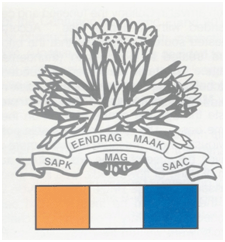
The establishment of the South African Armoured Corps (SAAC) was proclaimed shortly after the Second World War in Government Gazette No 3716 of 18 October 1946. The history of Armour in South Africa, however, dates back much further. Armour and the principles of firepower, mobility and shock effect, date back to the cavalry that once was a decisive arm of battle. Cavalry was introduced to Southern Africa by the British forces before the turn of the 20th century. The principle of mounted operations was used by the British forces and, although on a far more informal scale, also used extensively by the Boer forces during the Anglo-Boer War of 1899 - 1902. The first real Armoured Fighting Vehicles (AFV) were introduced to Southern Africa by the Royal Naval Air Service when they used armoured cars to support South African forces in capturing German South West Africa (Namibia) in 1915. After the First World War the South African government acquired in a single Whippet Tank from Britain and used it to control the 1922 Witwatersrand Strike. In February 1922, two Grossley Armoured Cars were also acquired. During the severe economic depression of 1933, the government established a Special Service Battalion on 1 May 1933 as a job opportunity and social upliftment project. The Springbok was first used as a symbol for the unit until it was changed to the national flower - the Protea - in July 1934, which is still used today. The Special Service Battalion was converted to an armoured car regiment at the start of the Second World War, and later to a tank regiment. In April 1943, the Special Service Battalion was deployed in North Africa and used a black beret sporting silver proteas as a badge and a "flash" with red/orange, white and blue as its colours. When the South African Armoured Corps was thus officially proclaimed in 1946 and Special Service Battalion was included in the corps as the only full-time unit, its symbols and colours were incorporated. Army Training Instruction 7/59 authorised the South African Armour Corps colours as Orange (BS 1557) over Blue (BS 1104). The colours orange and blue were, however, divided by a metal colour namely silver. Any regimental numbering, tactical call signs and other indicators were to be in silver. The School of Armour was established on 1 April 1966 and adopted these South African Armour Corps colours and the proteas in their insignia and emblems. The South African Army started using stable-belts in 1983 and the South African Armour Corps adopted the colours of the beret flash for the belt. On 24 July 1996, the Chief of the South African National Defence Force approved the colours (and flag) for the South African Armour Corps as orange over blue, divided by silver/white. On its 50th anniversary in 1996 the South African Armour Corps officially adopted the mailed fist emblem with protea as the corps symbol to clearly distinguish it from the Special Service Battalion's emblem adopted and used since 1946. Through political changes in 1948 and 1994, the colours and symbols of the South African Armour Corps have been retained and to date these colours have distinguished the South African Armour Corps that ha loyal served various governments with distinction. The SA Armoured Corps is known for its professional and dedicated soldiers who proudly serve their country under their traditional corps symbols and colours. Armour Museum History The idea of instituting a Museum and Research Library for the South African Armoured Corps started as early as 1994 and was officially approved by the Chief of the SA Army on 12 October 1995. Approval for the use of a historical building located in the lines of the School of Armour, Tempe was granted in April 1995. Unfortunately, no funds were approved for the museum, although the Department of Public Works restored the building. A number of fund raising projects were launched and with donations from various private business and arms manufacturers, funds were raised to manufacture a number of showcases and other items. An appeal to all members of the Armoured Corps and other interested persons resulted in a number of different items being donated to the museum. With great success and with the assistance of personnel from the School of Armour, the museum was officially opened by the Chief of the Army on 13 September 1996 to coincide with the 50th anniversary celebrations of the South African Armoured Corps. To date, the museum has gone from strength to strength accumulating vast quantities of various items of interest and the collection of numerous armoured tracked, wheeled and other vehicles. The historical building dates back to the years 1902 - 1904 and stands on historical grounds in Tempe, the farm on which British occupying forces were garrisoned after the occupation of Bloemfontein on 14 March 1900. The large British Garrison (soldiers and families) soon had a need for a military hospital. Between 1902 and 1904, three large pre-fabricated wood and corrugated zinc buildings were erected for this purpose. Accompanying these hospital wards were pre-fabricated administration blocks and nurses-quarters. The hospital also cared for women and children of the concentration camps, (Anglo Boer war 1899 -1902). These concentration camps were adjacent to this area. The British Garrison used the hospital complex until 1912 - 1913. After the establishment of the SA Union Defence Force in 1910, the hospital was declared a Military Medical Service Training Facility in 1912. The hospital also functioned as a military hospital until it was closed in October 1921. In 1923, the facilities were sold to the Bloemfontein City Council for the price of •17 500,00 and were then used as an isolation hospital during several epidemics, such as the polio epidemics of 1934 and 1943. During the 1943 epidemic, the first Iron Lung was introduced to a hospital in South Africa to treat patients with lung conditions. In 1966, the hospital started scaling down and early 1967 the now disbanded 2nd Armoured Car Regiment moved in to occupy the area and buildings. During the same year, the School of Armour took over from 2nd Armoured Car Regiment and in 1970 the final historical building was taken over by the School of Armour. In 1985, some of the buildings from that era were demolished to make way for new buildings for the School of Armour. In 1995, the historical building was restored to its present condition. On 5 February 1999, this historical building was declared a national monument. To date, the building houses indoor displays of the SA Armour Museum, an auditorium and a functional hall. Adjacent to and part of the museum is the research library, which specialises in the gathering of information, documents, periodicals, books, etc with emphasis on armour warfare and equipment. The library also accumulates information on personnel, vehicles and archive books of the South African Armour Corps in particular. The library is in possession of a vast quantity of books, periodicals, documents, etc for research purposes. This library also responds to requests from around the world concerning equipment and history of the South African Armour Corps. "Hull-Down" was officially opened on 2 September 1999 by Brig Gen Fido Smit (Honorary Colonel 1 Special Service Battalion) and houses additional equipment and training aids that cannot be housed in the museum building due to limited space. Within the lines of the School of Armour and 1 South African Tank Regiment, some sixty plus armoured, tracked and wheeled vehicles are displayed. Other equipment such as guns, radar, mine rollers and ploughs are also displayed. "Lesakeng" (the Corral for old Horses) houses numerous armoured, tracked and wheeled and other vehicles, mainly runners. The total structure as it stands to date was developed and constructed with donations from private funds, and good friends of the museum. "Lesakeng" was officially opened on 30 March 2001. The enclosure is an ongoing process, as funds become available with the final goal of laying a concrete floor. Customs and Traditions The Chinese philosopher Sun Tzu once said: "The supreme excellence is not to man a hundred victories in a hundred battles. The supreme excellence is to subdue the armies of your enemies without even having to fight them ". This excellence can only be expected from a well-motivated army with real character; character that derives from a prominent, well-established culture. Customs and traditions form the cornerstone of the culture of any particular group. Culture, I believe, is the cement for building the future of society. Military culture, a subculture of society at large, which is practised in a disciplined environment, is based upon, inter alia, pride in the uniform, emblems and insignia, and particular customs and traditions. A unique military culture is in the process of development in the South African National Defence Force, and in the South African Army in particular. The South African Armoured Corps has a history of just more than half a century. Members of the South African Armour Corps, past and present, take pride in this illustrious history. It has been a remarkable period in the annals of the South African Army. The Armoured Corps has produced leaders and soldiers of exceptional quality in this relatively short period of time. These men and women were, and still are, all committed to the upholding of their Armour traditions, thus forming the special bond that exists within the Corps. Although a more specific culture has emerged over the years through the active participation of the Part-time Component in the activities of the South African National Defence Force, and this culture has also been projected in the South African Armour Corps through its Reserve Force Units, the South African Armour Corps traditions only gained momentum in the early 1990. The then command cadre at the School of Armour created an environment in which customs and traditions were exercised frequently and executed with the necessary pomp, dignity and ceremony. I hereby pay tribute to those leaders of the School of Armour who gave form to the customs and traditions and also to those who are now taking the unselfish task upon themselves to record these traditions and thereby preserving it for future South African Armour generations. This commendable effort also coincides with the early years of building on and creating a new military culture subsequent to the formation of our new South African National Defence Force. Tradition is certainly an important building block in the creation of our distinct Armour culture. It should therefore be all-inclusive. It should be accepted by all and practised by all. The Armour again takes the lead in building bridges based on sound and healthy human relations. I express the wish that the traditions of the Armoured Corps, as recorded in this booklet, will continue to serve as a force multiplier in building relations and living the culture. It is, without doubt, a morale booster in our endeavours to prepare the force, an excellent force, for whatever future challenge. Symbolism: The Flame of the Armour The Flame of the Armour symbolises the inextinguishable spirit and energy of the South African Army Armoured Corps. The flame reminds us of the following qualities:
The Flame also reminds us of the fire within every Armour soldier that enables him or her to deliver extraordinary performance and achievements. Irrespective of the enemy, we will advance and go forward with the flame in our hearts. The Flame also reminds us of the destructive firepower that the Armour can concentrate on the enemies of our country, in order to ensure peace and stability. The Flame of the Armour also embraces the national torch of tolerance symbolising that outwardly we are people of many colours, many races, many cultures, many languages, many religions and many origins, yet we are all tied to one another by a million visible and invisible threads that make us share a common destiny from which none of us can escape! The Flame of the Armour inspires members of the South African Army Armoured Corps to stand firm and proud - faithful to God, our country and our task. Faithful, true and steady - come what may, we are ready. Symbolism From the establishment, all SA Army Armoured Corps Regular Force members, except recruits, wore the chromium-plated white metal badge of the Special Service Battalion. This badge was worn until 1963. In 1963, the Special Service Battalion's badge was adopted for use by the SA Army Armoured Corps but the letters "SSB/SDB" were replaced with the letters "SAAC/SAPK".
The Tanker's Prayer
I pray Thee, Heavenly Father,
Be with us for we need
Please keep our tank from running dry
Please keep our radios in shape
Please our ammo coming,
And if we fall in combat,
We ask Thee, Heavenly Father, Amen The Armour Song
When icy winds blow your way,
Armour man, still be true,
Artillery shots disturb the night.
Armour man, still be true,
And when the winds of change do come,
Armour man, still be true, For More Information please visit www.saarmourassociation.co.za
|
 |